- Online only
- On sale!
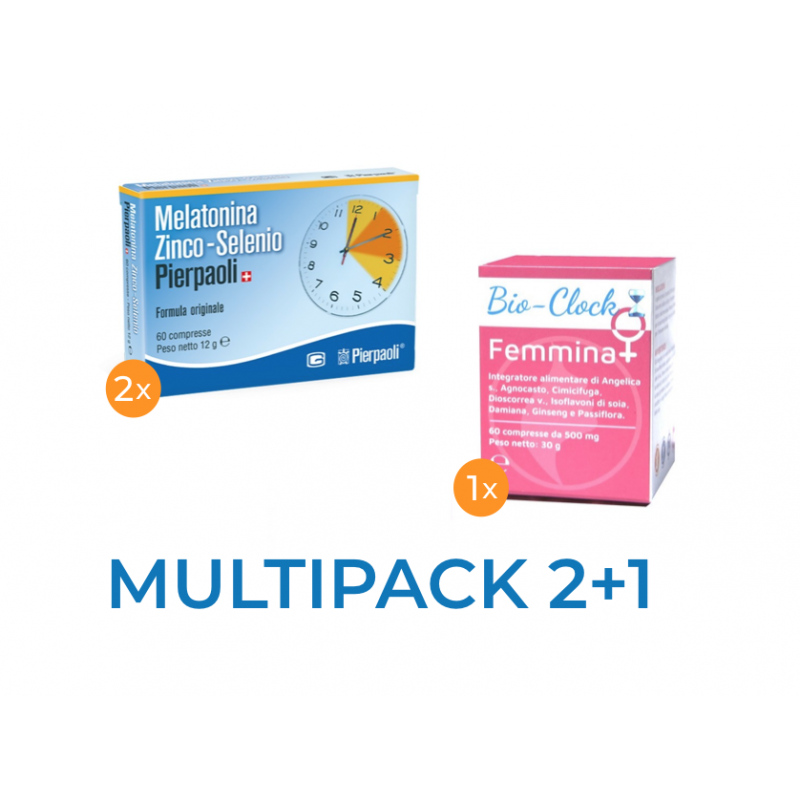

THIS OFFER CONTAINS:
1 Box FEMMINA +
Natural products to support women with PREMENOPAUSAL and MENOPAUSAL disease
Angelica s., Agnocasto, Cimicifuga, Dioscorea v., Soy Isoflavones, Damiana, Ginseng and Passiflora Food Supplement.
60 tablets of 500 mg - Net weight: 30 g
2 Boxes MELATONIN ZNSE Dr. Pierpaoli
The only melatonin formulated on the basis of scientific evidence and research conducted by Professor Pierpaoli.
THIS OFFER CONTAINS:
1 Box FEMMINA +
Natural products to support women with PREMENOPAUSAL and MENOPAUSAL disease
Angelica s., Agnocasto, Cimicifuga, Dioscorea v., Soy Isoflavones, Damiana, Ginseng and Passiflora Food Supplement.
60 tablets of 500 mg - Net weight: 30 g
2 Boxes MELATONIN ZNSE Dr. Pierpaoli
The only melatonin formulated on the basis of scientific evidence and research conducted by Professor Pierpaoli.
Natural products to support women with PREMENOPAUSAL and MENOPAUSAL disease
Angelica s., Agnocasto, Cimicifuga, Dioscorea v., Soy Isoflavones, Damiana, Ginseng and Passiflora Food Supplement.
60 tablets of 500 mg - Net weight: 30 g
INDICATIONS: Angelica sinensis, Agnocasto, Cimicifuga and Dioscorrosis are useful in counteracting menopausal disorders; Ginseng and Damiana for physical and mental fatigue; The Passiflora for mental well-being.
INGREDIENTS: charge Agent: Microcrystalline Cellulose - Angelica sinensis Diels. Radice e.s. 1% ligustilide - Agnocasto fruit (Vitex agnus-castus L.) e.s. 0.5% agnuside - Cymicifuga rhizome (Cimicifuga Racemosa Nutt.) E.s. 2.5% saponine triterpenoids - Dioscorella villosa L. rizoma e.s. 16% diosgenine Passiflora incarnata L. plant e.s. 3.5% vitexin - Damiana leaf (Turner diffuse Willd.) E.s. 4: 1 - Soya seeds (Glicine max Merr.) E.s. 36% isoflavones - Panax ginseng root C.A. Meyer. ) 80% ginsenosides - Pepper black (Piper nigrum L.) e.s. 95% Piperine - Anti Agglomerant: Silicon Dioxide - Magnesium stearate plant.
METHOD OF USE: it is recommended to take 2-4 tablets per day.
WARNINGS: supplements should not be considered as a substitute for a varied, balanced diet and a healthy lifestyle. Keep out of the reach of children under 3 years of age.
Do not exceed the recommended daily dose. Store the product in a cool, dry place away from light.
PROPERTIES AND USES INDICATIONS: Premenopausal, menopausal and post-menopausal disorders such as flushes, diarrhea, headache, difficulty breathing and depression may be caused by a lack of estrogen.
Selected officinal plants - which interact synergistically with each other by preventing or alleviating annoying disorders caused by changes in the hormonal situation - help the woman to face this important stage of her life with serenity.
Agnocasto - Fruits contain, in addition to iridoids and flavonoids, phyto-composted hormone activity such as progesterone and 17 alpha-hydroxypropygesterone, which can increase the production of luteinizing hormone.
Dioscorrosis - Contains diosgenin, which is a hormone precursor of progesterone, promoting hormonal equilibrium.
Angelica s. - It acts as a balancer of the estrogenic strain of all female hormonal disorders.
Passiflora - It acts as calming and sedative on the central nervous system in anxious states.
Damiana - It has a tonic-stimulating action, favoring the woman's normal sexual desire.
Ginseng - Boosts physical strength, helps to contain menopausal disorders, stimulates tone and vitality, and fights physical stress.
Isoflavone Soya - It is attributed an important estrogen-like action (genisteina-daidzeina) for the ability to bind to the same receptors used by estrogen. Soy protein is useful in increasing bone density, which is a factor of defense against the onset of osteoporosis and has also been effective in decreasing "heat flushes"
Cimicifuca - The cimicifuca root contains triterpenic glycides (actein and 27-desosglycine), alkaloids, fatty acids, salicylic acid, tannins, cimicifugin or macrotin (resin), racemosine, flavonoids, oligoelements that confer on the plant anti-inflammatory properties and re-calibrate the system Hormone, for the plant's ability to imitate serotonin and thus relieve the neurovegetative disorders of menopause and heat flushes.
Scientific research has shown that the use of cimetics on menopausal disorders has led to improvements in neurovegetative symptoms such as hot flashes, sweats, headaches, dizziness, heart palpitations, ears, nervousness and irritability, disturbances Sleep and depressive states.
The phytoestrogens of the cimetiphus are able to bind to serotonin receptors in the hypothalamus (a nucleus of nerve cells located at the lower part of the brain), thus carrying out an action similar to that of this neurotransmitter useful in the treatment of menopausal syndrome , Premenstrual syndrome, dysmenorrhoea (painful menstrual periods) and oligomenorrhoea (poor menstruation).
Piperine - As the name suggests, piperine is an alkaloid contained in the Piper nigrum, or the common black pepper. It is a crystalline substance, sometimes tending to yellow, with a very bitter flavor, as well as recognizable: piperine, in fact, is the principal responsible for the spicy taste of pepper. In the black one is contained in abundance, from 5 to 8% of weight, and is usually taken with the usual spice consumption or, alternatively, by supplements and other products.
Isolated for the first time in 1820 by Hans Christian Ørsted, a Danish chemist at the University of Copenhagen, piperine has long been studied and analyzed due to its effects on the body.
Not surprisingly, the characteristics of black pepper are already known since ancient times, so much so that they are also part of the compilation of secular knowledge related to the Ayurvedic tradition.
Like most spicy substances, piperine exhibits strong thermogenic activity, which is useful in accelerating metabolism and burning fat.
It therefore increases saliva production and gastric secretion, stimulates intestinal transit by helping absorb nutrients, and still demonstrates antioxidant activities, ideal for counteracting free radicals and cellular aging.
It also stimulates the production of endorphin in the brain and seems to act as a natural antidepressant.
The Effectiveness of Femmina + is indicated for:

Melatonin Zinc-Selenium is a dietary supplement with melatonin, zinc and selenium that was developed with the intent of achieving a peak in the release of Melatonin during the night, which helps re-establish the nocturnal peak of melatonin.
Melatonin Zn-Se Dr.Pierpaoli:
• Rebalances hormonal, metabolic and immune functions;
• Protects the Pineal gland, maintaining its functions;
• Maintains youthful metabolic conditions;
• Synchronizes physiological cycles of the body;
• Helps in situations of fatigue and stress;
• Helps in deficient physiological conditions;
• Helps in resolving sleep-wake rhythms; •
Helps with jet-lag;
Melatonin is a simple natural synthesized molecule, in addition to the pineal gland, it can also be found in numerous other organs and tissues such as, for example, the retina, intestinal mucosa, in megakaryocytes and in platelets. Melatonin is omnipresent in nature: it has also been found in many plants, including many for food use. In humans it is mainly synthesized by the pineal gland, which regulates the synthesis and cyclic secretion of hormones in our organism and is responsible for the nocturnal peak of melatonin. The nocturnal melatonin peak initiates a sequence of effects that keep the body in sync with the physiological cyclicity of hormones and cells. It is during childhood that the production of Melatonin reaches its peak, then begins to gradually decrease and dwindle away until it disappears in old age.
Melatonin Night Peak
The uniqueness of Pierpaoli Melatonin Zinc-Selenium lies in that it has been developed with intent to achieve a peak release of melatonin between 1 and 3 a.m. comparable to that produced in the same time slot by the pineal gland during youth.
According to my research, by replicating the physiological nocturnal peak typical of youth, you are helping the pineal gland to regenerate and stay young and to produce molecules that regulate the entire hormonal system also called "neuroendocrine” system. It helps preserve the biological rhythms that control hormones and immunity, as well as circadian synchronization (physiological cyclicity) of the neuroendocrine system that regulates the body's natural metabolic and immunological functions. Result: it favors the normalization of all endocrine, immunological, and metabolic functions.
Why is 1 milligram enough?
Melatonin does not have a quantitative pharmacological value, as has been demonstrated in hundreds of scientific journals, but is only necessary to “rest” the pineal gland. The “physiological” (dose-dependent) effect of taking Melatonin is obtained within the range of physiological values of the endogenous plasma melatonin (50-200 pg / ml) with equal doses, in a young healthy adult, at 0.1-0.3 mg. It has been proven that doses of 0.3 - 0.5 mg are already effective and are able to perfectly imitate a youthful nocturnal peak. Administering 0.3 mg doses of Melatonin to adult males will result in blood levels close to physiological levels. A 0.3 mg dose of Melatonin is in fact sufficient to increase the level of Melatonin in blood about 120 picograms per milliliter, a level that corresponds to the nocturnal peak of melatonin in youth.
It should, however, be considered that individual needs may vary according to differences in metabolism. Precisely because everybody has a different intestinal absorption, I prudentially suggest taking 1 to 3 mg. There is no risk of overdose. Melatonin is water-soluble, and the excess quantity is eliminated by kidneys in the urine. During a clinical study, a daily dose of 6 grams (or 6,000 times higher than recommended) was given to some women for a long period of time without the appearance of any side effects. In fact, as we have said, a dose of 0.3 - 1.0 mg Melatonin Zinc-Selenium tablets is normally sufficient to return the nocturnal peak of melatonin to youthful levels and to saturate the organism during the night.
Epuphysis/Pineal Gland:
The pineal gland (or epiphysis), which regulates the synthesis and cyclical secretion of hormones in our body, Melatonin Plasma Levels Decline Rapidly with Ageproduces melatonin. As it ages, it produces increasingly less melatonin. During childhood, melatonin production reaches its maximum peak. It then begins to decline slowly: at about 45, there is a further drop and at around 80 the level of melatonin in the body of an otherwise healthy individual is less than half that of a young individual.
Hormones and all molecules in the body closely follow a day-night (circadian rhythms), sun-moon and seasons cycle (especially light and temperature). These cycles are the foundation of health. Aging is also due to the break in the synchronized relationship between circadian/seasonal and hormonal rhythms. This relationship is regulated by the structures of the nervous system forming the hypothalamic-pituitary-pineal brain circuit, which integrates and synchronizes the night-day cycles of the synthesis and secretion of all hormones. Aging in humans is, therefore, certainly linked to a genetic program, but the expression of this program is precisely the circadian periodicity of the hormone system.
In turn, day and night hormonal cycles and rhythms are closely controlled by the stimulation of the pineal gland, which integrates and sends back messages to the endocrine glands.
he pineal gland (or epiphysis), which regulates the synthesis and cyclical secretion of hormones in our body, Melatonin Plasma Levels Decline Rapidly with Ageproduces melatonin. As it ages, it produces increasingly less melatonin.
During childhood, melatonin production reaches its maximum peak. It then begins to decline slowly: at about 45, there is a further drop and at around 80 the level of melatonin in the body of an otherwise healthy individual is less than half that of a young individual. Levelling until the complete disappearance of the nocturnal melatonin peak, in addition to the constant reduction of zinc levels with aging, are tell-tale signals of the body's aging and of the decline of hormonal control over our essential functions, including sleep, strength, adaptation to temperatures, sexual vigor, resistance to infections and so forth.
It is, therefore, a matter of preventing this trend by administering a correct amount of melatonin to maintain a constant nocturnal peak typical of youth. By doing so, you are helping the pineal gland and, therefore, the entire body to recover that youthful condition that is essential to preserve the biological rhythms that control hormones and immunity, as well as circadian synchronization (physiological cyclicity) of the entire hormonal system that closely Normal Melatonin Peaksregulates natural metabolic and immunological functions. This favors, accordingly, the normalization of all immunological, metabolic and endocrine functions.
Since the pineal gland produces melatonin only at night, by taking the correct amount of melatonin at night (and obtaining the corresponding melatonin peak during the night), the pineal gland no longer needs to produce melatonin through a very complex synthesis process and "goes to rest”. This way, you can help to preserve and protect the functional integrity of the pineal gland and, therefore, restore all hormonal rhythms in addition to slowing down aging (which is certainly a clearly genetically programmed process in the brain, but which is expressed through hormonal regulation).
Why Zinc and Selenium?
Zinc and selenium are two molecules that cooperate and synergize with melatonin to regulate and resynchronize hormonal, metabolic and immune functions which are altered during aging. For instance, a number of studies and experiments have shown that zinc can help to redress immunodepression generated by aging and other hormonal and metabolic alterations typical of old age. Furthermore, with age, zinc is not absorbed enough through the bowels and is a certain indicator of aging (elderly people have very low zinc levels) and must, therefore, be supplemented to prevent alteration of immunity.
For this reason, in Pierpaoli Melatonin, the three fundamental anti-aging molecules (melatonin, zinc and selenium) are combined in a single synergistic blend, which is designed to achieve the maximum beneficial effect in the metabolic and immunobiological system of people who take it.
To assess the beneficial effects of Pierpaoli® Melatonin Zinc-Selenium, all you need is a normal blood test before you start taking it and then check again after 6 months or a year (in the absence of diseases, we recommend that you always measure FT3, FT4, TSH, prolactin and testosterone).
Composition:
Melatonin, Zinc gluconate, Seleniomethionine and Mannitol
Instruction for use:
We recommend taking one tablet of Pierpaoli’s Melatonin Zinc-Selenium in the evening half an hour before going to sleep, and in any case preferably between 10 p.m. and midnight.
Warnings:
Do not exceed the recommended daily dose. Supplements are not intended as a substitute for a varied, balanced diet and healthy lifestyle. Keep out of reach of children under three years of age, do not take while pregnant, keep at a temperature below 25° C and protect from light. Excessive use may cause laxative effects.
Safety considerations for Pierpaoli’s Melatonin Zinc-Selenium
(Source: http://www.pierpaoli.ch/ENG/Melatonin-Zn-Se-Pierpaoli-1ec45800)
In general
The use of Melatonin at the recommended doses is safe. Melatonin is generally well tolerated and has no side effects. No harmful or dangerous side effects have been identified in the 20 years during which tens of millions of people have taken Melatonin. Numerous scientific publications and studies confirm the safety and beneficial effects of Melatonin. Melatonin is practically free of contraindications and clinically relevant undesirable effects when taken according to instructions.
Pierpaoli’s Melatonin Zinc-Selenium does not create addiction or dependency. Stopping the administration of exogenous Melatonin, the pineal gland resumes synthesizing the endogenous molecule in physiological quantities.
Interactions
For people taking medication before starting with Pierpaoli’s Melatonin-Zinc-Selenium, as more generally, with any other type of dietary supplement, we recommend consulting with your doctor. Although the pharmacokinetic/pharmacodynamic characteristics of Melatonin are theoretically modulated by other active substances, at the moment there are no known interactions that are of particular concern from a clinical viewpoint.
Special population groups
For precautionary purposes, we recommend that you always consult your doctor before taking Melatonin if you suffer from: severe hepatic impairment and rheumatoid arthritis, given that, to date, there is not a great number of clinical observations in patients, it is necessary to validate the studies that prove the beneficial effects of Melatonin in these categories of people. Given the lack of studies in this regard, taking Melatonin should be avoided during pregnancy and subsequently while breastfeeding. In the absence of specific disorders healthy children and adolescents, with a lifestyle that does not affect the biological circadian rhythms (sleep-wake) usually do not suffer from inhibitions of the endogenous production of Melatonin and, therefore, unless a different specialised assessment proves otherwise, do not need to take Melatonin.
Prolonged use The use of Melatonin has been demonstrated as being safe in the short and middle term (6-18 months), even at higher doses.
However, for precautionary purposes, we advise you to inform your doctor if you use it for prolonged periods.
References:
1. JELLIN JM ET AL., EDS. Pharmacist’s letter/prescriber’s letter natural medici- nes comprehensive database.
2. HARTTER S ET AL. Increased bioavailability of oral melatonin after fluvoxami- ne coadministration. Clin Pharmacol Ther. 2000; 67:1-6.
3. VON BAHR C ET AL. Fluvoxamine but not citalopram increases serum me- latonin in healthy subjects -- an indication that cytochrome P450 CYP1A2 and CYP2C19 hydroxylate melatonin. Eur J Clin Pharmacol. 2000; 56:123-7.
4. LUSARDI P ET AL. Cardiovascular effects of melatonin in hypertensive pa- tients well controlled by nifedipine: a 24-hour study. Br J Clin Pharmacol. 2000; 49:423-7.
5. PIERPAOLI, W. AND REGELSON W. WITH CAROL COLMAN, “The Mela- tonin Miracle”, Simon & Schuster, New York, 1995.
6. PIERPAOLI, W. The pineal gland: a circadian or a seasonal aging clock? Aging 3: 99-101, 1991.
7. PIERPAOLI, W. DALL’ARA, A, PEDRINIS, E. AND REGELSON, W. The pineal control of aging. The effects of melatonin and pineal grafting on the survival of older mice.
8. Second Stromboli Conference on Aging and Cancer, June 1990. Ann. N.Y. Acad. Sci. 621: 291-313, 1991.
9. PIERPAOLI, W., AND LESNIKOV, V.A. The pineal aging clock. Evidence, mo- dels, mechanisms, interventions. The Aging Clock. Third Stromboli Conference on Agingand Cancer, June 1993. Ann. N.Y. Acad. Sci. 719: 461-473, 1994.
10. PIERPAOLI, W. AND REGELSON, W. Pineal control of aging: effect of mela- tonin and pineal grafting on aging mice. Proc. Natl. Acad. Sci. USA, 94: 787-791, 1994.
11. MOCCHEGIANI, E., BULIAN, D., SANTARELLI, L., TIBALDI, A., MUZZIOLI, M., PIERPAOLI, W. AND FABRIS, N. The immuno-reconstituting effect of melato- nin or pineal grafting and its relation to zinc pool in aging mice. J. Neuroimmunol. 53: 189-201, 1994. Melatonina Zinco-Selenio Dr.Pierpaoli
12. MOCCHEGIANI, E., BULIAN, D., SANTARELLI, L., TIBALDI, A., MUZZIOLI, M., LESNIKOV, V., PIERPAOLI, W. AND FABRIS, N. The zinc pool is involved in the immunoreconstituting effect of melatonin in pinealectomized mice. J. Phar- mac. & Exp. Therap. 277: 1200-1208, 1996.
13. MOCCHEGIANI, E., BULIAN, D., SANTARELLI, L., TIBALDI, A., PIERPAOLI, W. AND FABRIS, N. The zinc-melatonin interrelationship. A working hypothesis. The Aging Clock.
14. Third Stromboli Conference on Aging and Cancer, June 1993. Ann. N.Y. Acad. Sci. 719: 298-307. 1994.
15. FABRIS, N. Neuroendocrine-immune aging: an integrative view on the role of zinc. The Aging Clock. Third Stromboli Conference on Aging and Cancer, June 1993.
16. ANN. N.Y. Acad. Sci. 719: 353-368, 1994.
17. MEISTER, A. AND ANDERSON, M.E. Glutathione. Ann. Rev. Biochem. 52: 711-760, 1983.
18. PIERPAOLI, W. AND LESNIKOV, V.A. Theoretical considerations on the na- ture of the pineal “aging clock”. Gerontology 43: 20-25, 1997.
19. BELLIPANNI, G., BIANCHI. P, PIERPAOLI, W., BULIAN, D. AND ILYIA, E. Effects of melatonin in perimenopausal and menopausal women. A randomized and placebo controlled study. Exp. Gerontol. 36, 297-310, 2001.
